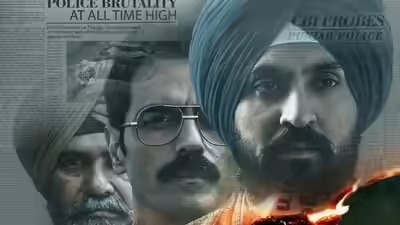
On 3 July 2026, Satluj, the story of slain Punjab human rights activist Jaswant Singh Khalra, was released on ZEE5. Within two days it quietly disappeared, “unavailable in India until further notice.” No published order. No public reasons.
This article is not against regulation. If a film genuinely threatens public order, national security or friendly relations with foreign States, Article 19(2) permits reasonable restrictions. The question is simpler: when that power is exercised, is there a fair process? Is the filmmaker heard? Can the decision be tested independently? Satluj shows that, today, the honest answer is no.
Two doors, two different rules
A theatrical release needs CBFC certification under the Cinematograph Act, 1952. The same film on an OTT platform needs no certificate; it is governed by Part III of the IT Rules, 2021, under which platforms self classify content.
Satluj walked through the second door. Submitted to the CBFC in 2022 as Punjab ’95, it reportedly faced 127 suggested cuts. The makers declined, litigated, withdrew, and after three years released it directly on ZEE5. Legally. The government saw circumvention; filmmakers saw a lawful route the Rules themselves created. That tension is why the framework needs repair.
The film also touches a raw chapter of our history. Critics say it tells one side: police brutality in full colour, with little attention to the Khalistani terrorism raging at the same time, which killed many police officers, including six IPS officers, and countless innocent civilians. To them, that whitewashes half of a two sided tragedy. Supporters respond that a biography of one man cannot narrate an entire insurgency. This article takes no position on that debate; it is exactly why process matters most on sensitive subjects.
The switch: how the takedown works
The takedown appears to rest on Section 69A of the IT Act, 2000, which permits blocking only on specified grounds: sovereignty and integrity of India, defence, security of the State, friendly relations with foreign States, public order, or incitement to a cognisable offence. The Supreme Court upheld it in Shreya Singhal v. Union of India because of its safeguards: written reasons, blocking tied to those grounds, orders testable in court. The Blocking Rules, 2009, provide a prior hearing, with an emergency route to block first and review later. An Inter Departmental Committee (IDC) of officials can recommend anything from a disclaimer to full blocking.
Where the process broke down
First, the order is invisible. The government’s explanation has reportedly come through unnamed officials, not a published order. A filmmaker cannot challenge what he has never seen; the Shreya Singhal safeguards cannot be invoked against a secret order. A right you cannot exercise is not a right. The Supreme Court has already warned against the State acting as a super censor, precisely because invisible suppression leaves nothing to challenge.
Second, the block came before the hearing, with no recorded urgency. The film went down on 5 July; the committee came a day later and heard the parties afterwards. The honest counter argument: if a film can truly inflame disorder, the damage is done before the lawyers finish. The law accepts this, which is why the emergency route exists and why, since Maneka Gandhi v. Union of India, a post decisional hearing can satisfy natural justice where a prior one would defeat the purpose. But the concession has two conditions: recorded urgency, and a prompt, time bound hearing that can undo the block. Here, no urgency is on record, no Section 69A ground has been named (“security concerns” is not one of the six), and the block runs on with no timeline.
The harm logic also faces a symmetry: the film streamed for two days, is being screened across Punjab by various organisations, and remains available abroad and through piracy, yet no disorder followed. Either the danger was speculative, or the real assessment must happen at the hearing anyway. The hearing is not a formality; it is the heart of the exercise.
Third, there is no appellate forum. The Film Certification Appellate Tribunal, the quick, inexpensive remedy for film disputes, was abolished in 2021. What remains is a writ petition: slow, costly, out of reach for independent producers.
Fourth, the Rules themselves are under a legal cloud. The Bombay High Court stayed key oversight provisions of these Rules in 2021, and the Madras High Court held the stay operates nationwide. Whether the Satluj direction relies on those stayed provisions is unclear. A mechanism of contested validity is switching films off.
But what about the one sided story?
The government’s strongest argument deserves an answer. The Khalra facts are a judicial record; the objection is to perspective. Interestingly, S. Rangarajan v. P. Jagjivan Ram itself concerned a film accused of a one sided, provocative take on reservation. The Court was clear: a biased perspective is not, by itself, a ground under Article 19(2). The danger must be real and proximate; where mobs threaten disorder, the State’s duty is to protect the film, not silence it. The remedy for a one sided film is criticism, debate and other films, not a ban; otherwise every historical drama is vulnerable, for every telling of history chooses a lens.
Yet a concession is due: perspective can slide into glorification or incitement, squarely attracting Article 19(2). Whether this film crosses that line is a question of judgment on evidence, for a fair forum after hearing the filmmaker, not for unnamed officials whose reasons no one can read. The one sided story argument does not weaken the case for due process; it is the best argument for it.
How to fix it: a fair forum for both sides
Five reforms would do most of the work. One, publish or at least serve every blocking order, with reasons tied to a specific ground; a feature film is not a state secret. Two, make a prior hearing the rule; reserve emergency blocking for recorded urgency, followed by a hearing within 48 to 72 hours, failing which the block lapses. Three, restore an FCAT style tribunal headed by a retired judge, covering both certification and blocking. Four, add a judicial member or independent experts to the IDC, so the government is not a complainant, judge and enforcer at once. Five, replace contested subordinate rules with a parliamentary law codifying the grounds, the procedure, a proportionality ladder (disclaimer, reclassification, modification, blocking) and the remedies.
Conclusion: the scissors and the switch
For seventy years, film censorship meant scissors: visible cuts, negotiated with a board, appealable before a tribunal. The OTT era has replaced the scissors with a switch that turns content off overnight, invisibly. The scissors were imperfect, but the filmmaker could at least see the blade. Regulation is not the enemy of free speech; unaccountable regulation is. A framework where the government states its ground, the filmmaker is heard, and an independent forum decides quickly protects the citizen’s right to watch, the filmmaker’s right to tell, and the government’s own credibility when it restricts. Satluj may or may not survive the review now underway. The process it has exposed should not survive in its current form.
Based on publicly reported information as of July 2026; review proceedings are ongoing and no final order is public. Views are academic, not legal advice.